Strength Training Fundamentals: Understanding Proper Form and Technique
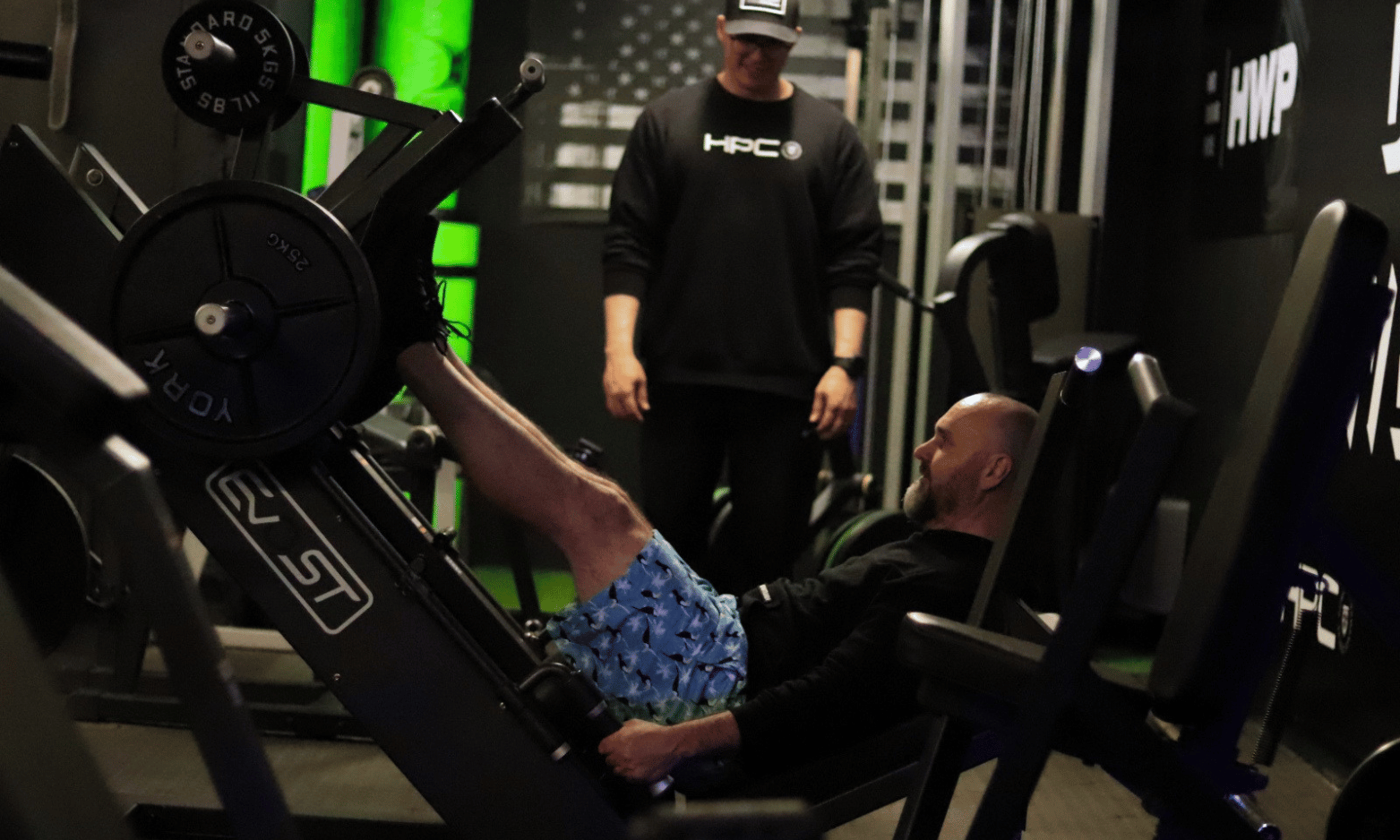
Anton Esterhuizen coaching a client during a strength training session at the HPC gym in Noordheuwel, Krugersdorp.
More weight doesn't automatically mean more progress.
Strength training is often reduced to a simple equation: lift heavier, do more repetitions, and get stronger.
But strength development is not simply about how much weight you can move.
How you move it matters.
The quality of your movement, the exercise you choose, the load you use, your ability to control the movement, and whether the exercise matches your current capacity all influence the outcome of your training.
At The Human Performance Centre, we believe effective strength training starts with understanding the fundamentals. Before asking how much more weight you can lift, it is worth asking a more important question:
Can you perform the movement well enough to create the adaptation you are actually looking for?
That is where proper form and technique become important.
Proper strength training technique means performing an exercise in a way that allows you to control the movement, manage its demands and create the intended training stimulus for your current level of ability.
What Does "Good Form" Actually Mean?
When people talk about proper form, they often imagine that there is one perfect position that everyone should reproduce.
Human movement is not quite that simple.
People have different anatomy, mobility, strength levels, training histories, goals and movement strategies. A position that works well for one person may not be appropriate for another.
Good form is therefore not simply about making an exercise look a certain way.
It is about creating a movement strategy that allows you to perform the exercise effectively for its intended purpose.
That means considering whether you can control the movement, manage the required range of motion, maintain the positions necessary for the task and produce the intended training stimulus.
This is why two people can perform the same exercise slightly differently and both execute it effectively.
The goal isn't to make everyone move identically.
The goal is to help the individual move effectively.
Form and Technique Are Not Quite the Same Thing
The words form and technique are often used interchangeably, but there is a useful distinction.
Form describes how a movement appears. Technique describes how effectively that movement is being executed for a particular purpose.
A movement can look different from the textbook example and still be effective.
For example, two people may squat with different torso positions because of differences in their proportions, mobility or training experience. That does not automatically mean that one person has "bad form."
What matters is whether the movement strategy allows the individual to meet the demands of the exercise safely and effectively.
This is also why a cue that works exceptionally well for one client may not work for another.
There is no universal instruction that can replace proper observation and coaching.
Why Technique Matters
Technique provides the framework through which strength training creates a training stimulus and, over time, an adaptation.
When an exercise is performed with appropriate technique, you are better able to control the movement and manage the demands placed on the body.
Poor technique can change that movement strategy.
You may compensate elsewhere, lose control, reduce the useful range of motion or shift the demands of the exercise away from what you originally intended to train.
You may even become better at moving a particular weight without meaningfully improving the quality you were trying to develop.
This is why we place so much emphasis on movement quality at HPC.
The goal isn't simply to complete a repetition.
The goal is to make the repetition useful.
And that starts with the basics.
The Fundamentals of Better Strength Training
1. Quality Before Load
One of the easiest traps in strength training is becoming too focused on the number on the bar.
It is not about how much weight you lift, but how well you lift it.
If increasing the load causes you to lose control, change your movement strategy or rely on compensations that take you away from the intended training stimulus, adding more weight may not represent meaningful progress.
This is where ego can interfere with training.
There is a reason why you may not be feeling the intended muscle working, and sometimes the solution isn't simply to add more weight. It may be a matter of refining the basics of the movement, changing the exercise or improving your ability to control the position.
At HPC, we have developed small but effective coaching cues over more than a decade of training that help our clients understand what they should be doing and, importantly, why they are doing it.
The objective is not to make an exercise look perfect.
The objective is to make the movement effective for you.
2. Use an Appropriate Range of Motion
Range of motion is another area where more is not automatically better.
The useful range for an exercise depends on the movement, the individual's structure and mobility, the training objective and their ability to control the position.
A deeper squat is not automatically a better squat.
A greater range of motion on a press is not automatically a better press.
The important question is whether the individual can access and control the range required for the intended outcome.
For example, if someone reaches a depth in a squat where they can no longer maintain the control required for the task, simply forcing them deeper does not necessarily improve the exercise.
Instead, we want to understand why that range is currently limited and what needs to improve.
Rather than chasing a position because someone else can achieve it, work within a range you can control and progressively develop your capacity from there.
3. Control the Movement
Strength training requires you to control both the lifting and lowering phases of an exercise.
This does not mean that every repetition needs to be performed extremely slowly.
Different training goals call for different movement speeds and tempos. An athlete training for power, for example, will have very different movement-speed requirements from someone performing a controlled hypertrophy-focused exercise.
What matters is that you can control the movement well enough to meet the demands of the exercise.
Learning to control the lowering phase can be particularly useful for developing body awareness and understanding how the exercise should feel.
It can also provide useful information about whether the weight you have selected is appropriate.
If you cannot control the movement, the load may be ahead of your current capacity.
That is not failure. It is information.
4. Develop Appropriate Stability and Bracing
Many strength exercises require you to create and maintain enough stability to transfer force effectively.
This becomes particularly important when the exercise places significant demands on the trunk.
You may hear cues such as "brace your core" or "keep your spine neutral," but these should not be treated as universal instructions that must look exactly the same for everyone.
Your spine is designed to move, and the position you use will depend on the task and the individual.
The objective is to develop the control and stability required for the movement rather than trying to hold the body rigidly in one position at all times.
For example, during a loaded squat or hinge, the trunk needs to provide enough control for force to be transferred between the lower body and the external load. Exactly how that position looks will vary between people.
This is another reason why coaching matters.
A useful cue should improve the movement.
If a cue doesn't improve the movement, another approach may be required.
5. Progress the Training — Not Just the Weight
Progressive overload is an important principle of strength training, but progression does not always mean adding more weight.
You can progress by improving:
Load
Repetitions
Range of motion
Movement control
Exercise complexity
Stability
Speed
Training volume
Technical consistency
A person who performs the same exercise with better control, a more useful range of motion and fewer compensations may have made significant progress without adding a single kilogram.
Strength training is about creating a stimulus that the body can adapt to.
As that adaptation occurs, the training demands can be progressed.
Sometimes that means adding weight.
Sometimes it means improving the quality of what you are already doing.
Form Is Not One-Size-Fits-All
This is one of the most important concepts to understand if you want to train effectively.
Walk into any gym and you will hear the same cues repeated:
"Chest up."
"Push your knees out."
"Pull your shoulders back."
"Brace your core."
These cues can be useful.
But they are not automatically correct for every person, every exercise or every situation.
Two people can perform the same exercise with slightly different positions and both execute the movement effectively.
Why?
Because they are different people.
Their anatomy is different. Their mobility is different. Their strength and coordination are different. Their training history is different. Their goals may be different.
Consider the squat.
Someone with longer femurs may naturally use a different torso position from someone with shorter femurs. Someone with limited ankle mobility may also use a different strategy to achieve the same general movement.
That does not mean one person is automatically performing a "wrong" squat.
It means the movement needs to be understood in context.
This is why coaching should involve more than handing someone an exercise and telling them how it is "supposed" to look.
At HPC, we look at the individual and the movement.
The cue comes after the observation.
The Right Exercise for the Right Person
There is a tendency in strength training to treat certain exercises as inherently superior.
The squat is better than a machine.
The deadlift is better than a simpler hinge.
Free weights are better than machines.
The more advanced the exercise, the better the training.
This isn't how we approach training.
The best exercise is not necessarily the most advanced exercise. It is the exercise that is most appropriate for the individual and the objective.
A machine can be an excellent training tool.
A supported exercise can be an excellent starting point.
A regression is not a lesser version of training.
It is a way of reducing the demands of an exercise so that you can develop the qualities required to eventually handle a more demanding variation.
Sometimes the most effective decision is to simplify the movement first.
Mastering Fundamental Movement Patterns
Rather than thinking only in terms of individual exercises, it is useful to understand the fundamental movement patterns that underpin strength training.
These include:
Squatting — producing and controlling force through the lower body.
Hip hinging — learning to load the hips while managing the position and movement of the trunk.
Pushing — producing force away from the body.
Pulling — producing force toward the body.
Carrying and stabilising — controlling the body and external load while moving or maintaining position.
These patterns can be trained through many different exercises.
The exercise itself is the tool.
The important question is whether that tool allows you to develop the quality you are trying to improve.
Mastering the Big Lifts
There are countless exercises available to you in a gym, but several foundational movements deserve attention because they can develop multiple physical qualities at once.
However, mastering these movements does not mean immediately performing their most advanced variation.
The Squat
The squat is a fundamental lower-body movement that can train the quadriceps, glutes, hamstrings and trunk musculature.
The movement involves coordinated motion through the ankle, knee and hip, while the trunk provides the stability needed to manage the external load.
Common coaching cues might include maintaining appropriate trunk control, allowing the knees to track appropriately with the feet and controlling the descent and ascent.
But these cues should not be treated as a checklist that every person must execute identically.
Your structure, mobility, experience and objective all influence how the squat should be coached.
For some people, a bodyweight squat may be the appropriate starting point.
For others, a supported or loaded variation may be more appropriate.
The goal is to find the version that allows the person to perform the movement effectively and then build from there.
The Deadlift
The deadlift is a demanding movement that requires coordination between the hips, lower body and trunk while producing force against an external load.
At its foundation is the ability to perform a hip hinge: loading the hips while managing the position of the trunk and maintaining control of the movement.
That sounds simple.
In practice, there is considerably more happening mechanically.
The person needs sufficient control, strength and coordination to manage the demands of the movement.
For that reason, we do not automatically start every client with a conventional deadlift.
Depending on the individual's current capacity, we may first develop the trunk, hip and lower-body strength required to perform more demanding hinge variations.
This is not about avoiding difficult exercises.
It is about preparing the person for them.
The Dumbbell Bench Press
The dumbbell bench press can develop the chest, shoulders and triceps while also requiring the individual to control two independent loads.
A stable base and appropriate shoulder and trunk positioning are important, but once again, the exact cues will differ between individuals.
The shoulder complex needs to manage the demands of the movement while the trunk and lower body provide a stable base from which force can be produced.
If someone experiences discomfort or struggles to control the movement, simply telling them to "fix their form" may not solve the problem.
A different exercise variation may be more appropriate.
A machine with a guided path, for example, may allow someone to develop the required strength and control before progressing toward a less supported movement.
Again, the exercise is not the goal.
The adaptation is the goal.
Regression Is Not Going Backwards
One of the biggest misconceptions in training is that moving to an easier exercise means you are losing progress.
It doesn't.
A regression is simply a way of reducing the demands of an exercise so that you can develop the qualities required to eventually handle a more demanding variation.
You might move through a process such as:
Simpler movement → controlled execution → increased capacity → greater complexity → increased load
That is progression.
Sometimes the best way forward is to take one step back and build the foundation properly.
This is particularly important for beginners, individuals returning to training and anyone attempting a movement that currently exceeds their capacity.
There is no value in forcing an exercise simply because it looks more impressive.
The body responds to the training stimulus and demands placed upon it, not to how advanced the exercise appears.
When Should You Change an Exercise?
Knowing how to perform an exercise is only part of effective training.
You also need to know when the exercise may no longer be the appropriate choice.
A movement may need to be modified when:
You cannot control the required range of motion.
You consistently lose the intended movement strategy as the load increases.
The exercise creates discomfort that is unusual, persistent or worsening.
You cannot achieve the intended training stimulus.
The exercise is unnecessarily complex for your current level of experience.
A different variation would allow you to train the same quality more effectively.
This is not about avoiding challenge.
Strength training should challenge you.
The question is whether the challenge is productive.
Coaching Makes the Difference
Good coaching is not about shouting motivation from across the gym.
It is about understanding what the person in front of you needs.
Sometimes that means a simple cue.
Sometimes it means changing the exercise.
Sometimes it means reducing the load.
Sometimes it means improving a prerequisite quality before returning to the original movement.
And sometimes the best coaching decision is knowing that the person is ready to progress.
Over more than a decade of training, we have developed small but effective coaching cues and progressions that help our clients understand their movement and improve their performance.
But there is no magic cue.
There is no single perfect exercise.
And there is no universal progression that works for everyone.
The role of the coach is to identify what the individual needs and then guide the training accordingly.
Strength Training Is a Process
Mastering form and technique is not something you complete once and then forget about.
As your strength increases, the demands placed on your body change.
As the exercise changes, your technical requirements change.
As your goals change, the training stimulus may need to change with them.
That is why effective strength training is a process of continuous learning and adaptation.
Assess. Learn. Adapt. Progress.
The objective is not to chase the heaviest weight, the most complicated exercise or the most impressive-looking movement.
It is to develop the physical capacity to perform the movements you need, with the appropriate level of control, strength and confidence.
This is why effective strength training starts before the first loaded repetition.
It starts with understanding the person, identifying their current capacity and selecting a starting point that allows them to train effectively.
From there, the process becomes one of building capacity, refining movement and progressively increasing the demands placed on the body.
At The Human Performance Centre, we believe training should be built around the individual rather than forcing the individual into a predetermined exercise selection.
Because better strength training isn't simply about doing more.
It is about doing what is appropriate, doing it well, and progressively building the capacity to do more.
That is where meaningful performance begins.
Continue Reading
Do You Really Need a Personal Trainer?
Understand the difference between knowing how to exercise and knowing how to train.
Why Training Is About More Than Fitness
Explore why effective training goes beyond simply getting fitter.
Warm-Up and Cool-Down: How to Prepare and Recover for Better Performance
Learn why preparation and recovery should be based on the demands of your training.
Key Takeaways
Good technique is individual. Effective form isn't about making everyone move identically. It is about finding a movement strategy that suits the individual, the exercise and the objective.
Earn the load before you add the load. If increasing weight compromises your control, range of motion or intended movement strategy, the load may be ahead of your current capacity.
The exercise is the tool. The adaptation is the goal. A machine, free weight, regression or progression can all be effective when they provide the right training stimulus for the person.
Progress isn't always measured in kilograms. Better control, greater range of motion, improved consistency, increased volume or greater capacity can all represent meaningful progress.
Regression isn't failure. Reducing the demands of an exercise can give you the opportunity to develop the strength, control and coordination required to progress.
The cue comes after the observation. There is no universal coaching cue that works for everyone. Effective coaching starts by understanding how the individual is moving and what they need.
Assess before you prescribe. The right starting point depends on the individual's movement, physical capacity, experience, training history and goals.
Frequently Asked Questions About Strength training
-
Form describes how a movement looks; technique is how effectively you execute that movement for a particular purpose.
There is often an assumption that good form means reproducing one perfect position. In reality, effective technique needs to account for the individual, the exercise, the training objective and the demands of the movement.
Two people may perform the same exercise with slightly different positions because of differences in anatomy, mobility, strength or experience. That does not automatically mean one has poor form.
The distinction matters because good training isn't about making everyone move the same. It's about finding a movement strategy that allows the individual to control the exercise and create the intended training stimulus.
-
Good form allows you to control the movement, manage its demands and create the intended training stimulus without unnecessary compensation.
Look beyond whether you can simply complete the repetition. Consider whether you can maintain control, access a useful range of motion and continue using an effective movement strategy as the exercise becomes more demanding.
If your technique changes significantly when you increase the load, you may be exceeding your current capacity.
Video feedback or experienced coaching can be particularly useful here. It can be difficult to recognise your own movement compensations while concentrating on completing the exercise.
The goal isn't to make an exercise look perfect.
The goal is to make the movement useful.
-
Beginners should focus first on learning fundamental movement patterns, developing control and building the capacity to train consistently before chasing heavy loads or complex movements.
This doesn't mean beginners need to spend months doing only bodyweight exercises. It means the exercise and its demands should match their current ability.
A supported movement, machine or simpler variation can be an excellent starting point if it allows someone to learn the required movement and develop strength with control.
You don't need to become "fit enough" before you start strength training. You need an appropriate starting point and a process that allows you to build from there.
As your capacity improves, the demands can gradually increase.
You don't need to start with the most advanced exercise. You need to start at the right level.
-
You should consider increasing the weight when you can consistently meet the demands of your current exercise while maintaining appropriate control, technique and range of motion.
Completing all your repetitions is useful information, but it is not the only measure of readiness.
If adding weight causes you to lose control, change your movement strategy or rely heavily on compensation, the increase may be ahead of your current capacity.
Progression can also come through more repetitions, greater range of motion, improved control, increased training volume or greater exercise complexity.
More weight is one form of progression, not the definition of progression.
-
No. A machine is simply another training tool.
Machines can provide additional stability or a guided movement path, which may allow someone to develop strength and control before progressing to a less supported variation.
Free weights create different demands and may require greater control in some situations, but that doesn't make them automatically superior.
The better question isn't:
"Which exercise looks more advanced?"
It is:
"Which exercise allows this person to develop the quality we are trying to improve?"
A regression isn't a step backwards if it allows you to build the capacity required for the next progression.
-
No. You need to develop the physical qualities required to manage the demands of the training you want to perform.
For some people, that may involve learning a simpler squat or hinge variation first. For others, their existing strength, coordination and movement control may already allow them to progress.
There is no universal timeline for mastering a particular exercise.
The same principle applies to the deadlift. It is a demanding movement, and not everyone needs to begin with a conventional deadlift. Developing the trunk, hip and lower-body strength required to manage the movement may be the more suitable starting point.
Progression should follow capacity, not ego or a predetermined timeline.
-
First, don't automatically assume that you need to push through it or simply "fix your form."
Training can feel challenging or unfamiliar as your body adapts to a new movement. That is different from pain or discomfort that is unusual, persistent or worsening.
If something doesn't feel right, consider whether the load, range of motion, exercise variation or movement strategy needs to change. If the problem persists or you are unsure what is causing it, having the movement appropriately assessed is a better approach than repeatedly forcing the exercise.
An exercise is not valuable simply because it is difficult.
The challenge should be productive.